Event image

Bach Cantatas with Marc Destrubé

Oct 10, 2026 - Oct 11, 2026

Bach composed over two hundred church cantatas during his long career as organist and music director in various cities including Mühlhausen, Weimar, and Leipzig. The precise number of cantatas is not known, since many were lost, but what is particularly amazing to the modern listener upon hearing the extant cantatas is that Bach was capable and willing to reinvent himself in composing each work, pouring his greatest creative effort into carefully illustrating a vast array of religious texts.

In this program, we’ll hear three of these masterpieces, BWV 54 Widerstehe doch der Sünde (Just resist sin), BWV 199 Mein Herze schwimmt im Blut (My heart swims in blood), and BWV 82 Ich habe genug (I have enough). BWV 54 and 199 both trace, in unique fashion, the spiritual arc from consummate seriousness, despair, and regret—sometimes a near vortex of darkness—into eventual understanding, and, finally, to joy. BWV 82 begins with the profound realization of Jesus’ earthly embodiment and sacrifice for humanity and then brings us to the inner peace and spiritual rejuvenation this knowledge brings.

Also on this program, by way of contrast, Marc Destrubé will play Bach’s sunny Violin Concerto in E major. We know that Bach studied Vivaldi assiduously, and it is wonderful to hear Vivaldi’s unmistakable presence in this work and how he positively inspired Bach!


PROGRAM: Widerstehe doch der Sünde BWV 54, Mein Herze schwimmt im Blut BWV 199, Ich habe genug BWV 82, Violin Concerto in E major BWV 1042


Read more
Event image

Bach Cantatas - LIVESTREAM

Sunday, October 11, 2026 - 2:10 PM CDT

Bach composed over two hundred church cantatas during his long career as organist and music director in various cities including Mühlhausen, Weimar, and Leipzig. The precise number of cantatas is not known, since many were lost, but what is particularly amazing to the modern listener upon hearing the extant cantatas is that Bach was capable and willing to reinvent himself in composing each work, pouring his greatest creative effort into carefully illustrating a vast array of religious texts.

In this program, we’ll hear three of these masterpieces, BWV 54 Widerstehe doch der Sünde (Just resist sin), BWV 199 Mein Herze schwimmt im Blut (My heart swims in blood), and BWV 82 Ich habe genug (I have enough). BWV 54 and 199 both trace, in unique fashion, the spiritual arc from consummate seriousness, despair, and regret—sometimes a near vortex of darkness—into eventual understanding, and, finally, to joy. BWV 82 begins with the profound realization of Jesus’ earthly embodiment and sacrifice for humanity and then brings us to the inner peace and spiritual rejuvenation this knowledge brings.

Also on this program, by way of contrast, Marc Destrubé will play Bach’s sunny Violin Concerto in E major. We know that Bach studied Vivaldi assiduously, and it is wonderful to hear Vivaldi’s unmistakable presence in this work and how he positively inspired Bach!


PROGRAM: Widerstehe doch der Sünde BWV 54, Mein Herze schwimmt im Blut BWV 199, Ich habe genug BWV 82, Violin Concerto in E major BWV 1042


Read more
Event image

Latin American Baroque - 16th Annual Holiday Concert at FOUR WINDS FARM

Friday, December 11, 2026 - 7:30 PM CST

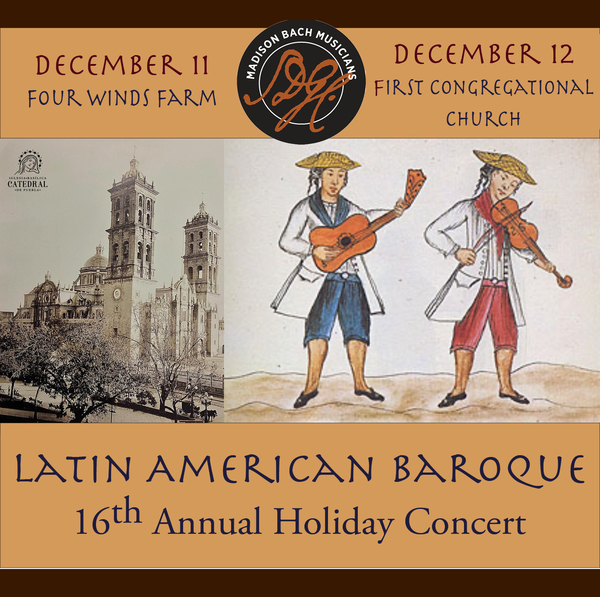
In our 16th Annual Holiday Concert, we’ll immerse ourselves in music composed in Central and South America during the 16th, 17th, and 18th centuries. The mixture of styles was exceedingly complex and constantly changing as Indigenous cultures interacted not only with each other but also with influences from Europe, primarily in the form of Spanish and Portuguese colonization and persistent proselytizing and religious conversion by the Catholic Church. From what is modern-day Mexico, we’ll hear villancicos (Christmas Carols) and other masterworks by Juan Gutiérrez de Padilla (c. 1590–1664) and Gaspar Fernandez (c. 1566–1629) who both worked at the great cathedral in Puebla. Their music creatively and consistently integrates indigenous and European models. 

We’ll also hear Serenísima una Noche, a villancico by Fr. Jerónimo González de Mendoza (c. 1633–1661) from Puebla and a beautiful lullaby Xicochi Conetzintle adapted by Fernandez in Nahuatl, a prominent Indigenous language in Mexico. The program features several songs from a remarkable 1785 collection known as the Trujillo Codex. Assembled by Bishop Martinez for the King of Spain, the Codex brought together over 1400 watercolor paintings and musical scores documenting Indigenous life (people, customs, flora, fauna, and geography) in colonial Peru. We’ll hear the elegant cantata O Daliso for soprano and continuo by Domenico Zipoli (1688–1726) (an Italian Jesuit who worked in the Spanish Viceroyalty of Peru); the thrilling and jaunty tenor solo, Vaya de Jácara, Amigos, by Guatemalan composer Raphael Castellanos (1725–1791); and a recorder arrangement of an 18th-century Bolivian song La Matutina Estrella.
Read more
Event image

Latin American Baroque - LIVESTREAM

Saturday, December 12, 2026 - 2:10 PM CST

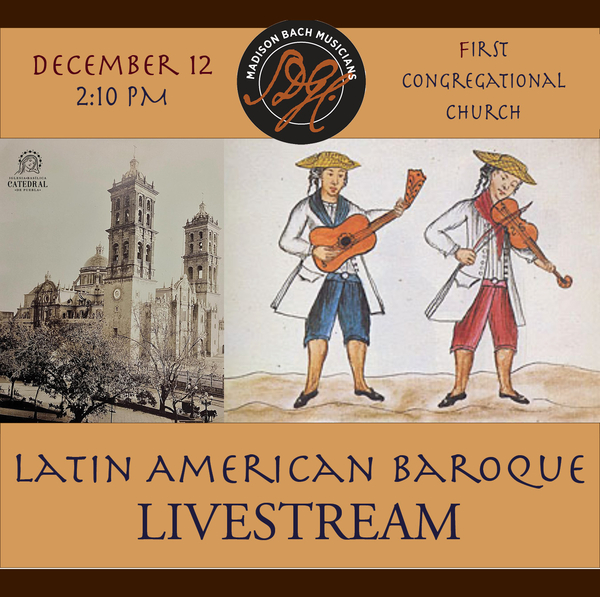
In our 16th Annual Holiday Concert, we’ll immerse ourselves in music composed in Central and South America during the 16th, 17th, and 18th centuries. The mixture of styles was exceedingly complex and constantly changing as Indigenous cultures interacted not only with each other but also with influences from Europe, primarily in the form of Spanish and Portuguese colonization and persistent proselytizing and religious conversion by the Catholic Church. From what is modern-day Mexico, we’ll hear villancicos (Christmas Carols) and other masterworks by Juan Gutiérrez de Padilla (c. 1590–1664) and Gaspar Fernandez (c. 1566–1629) who both worked at the great cathedral in Puebla. Their music creatively and consistently integrates indigenous and European models. 

We’ll also hear Serenísima una Noche, a villancico by Fr. Jerónimo González de Mendoza (c. 1633–1661) from Puebla and a beautiful lullaby Xicochi Conetzintle adapted by Fernandez in Nahuatl, a prominent Indigenous language in Mexico. The program features several songs from a remarkable 1785 collection known as the Trujillo Codex. Assembled by Bishop Martinez for the King of Spain, the Codex brought together over 1400 watercolor paintings and musical scores documenting Indigenous life (people, customs, flora, fauna, and geography) in colonial Peru. We’ll hear the elegant cantata O Daliso for soprano and continuo by Domenico Zipoli (1688–1726) (an Italian Jesuit who worked in the Spanish Viceroyalty of Peru); the thrilling and jaunty tenor solo, Vaya de Jácara, Amigos, by Guatemalan composer Raphael Castellanos (1725–1791); and a recorder arrangement of an 18th-century Bolivian song La Matutina Estrella.

Read more
Event image

Latin American Baroque - 16th Annual Holiday Concert at FIRST CONGREGATIONAL CHURCH

Saturday, December 12, 2026 - 3:00 PM CST
First Congregational Church, Madison

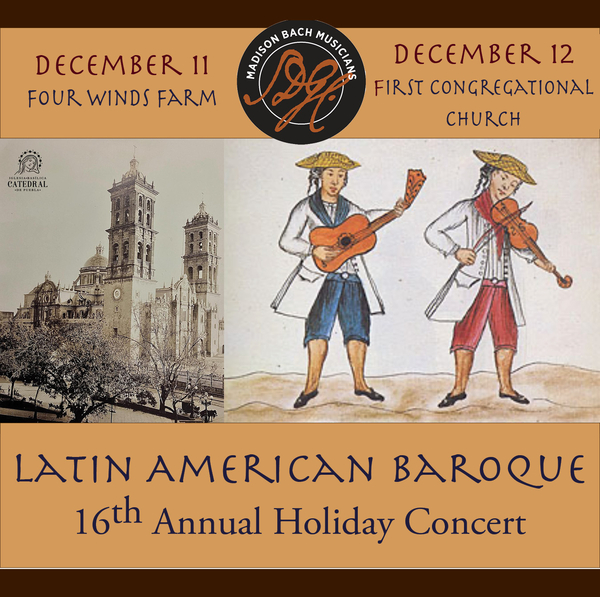
In our 16th Annual Holiday Concert, we’ll immerse ourselves in music composed in Central and South America during the 16th, 17th, and 18th centuries. The mixture of styles was exceedingly complex and constantly changing as Indigenous cultures interacted not only with each other but also with influences from Europe, primarily in the form of Spanish and Portuguese colonization and persistent proselytizing and religious conversion by the Catholic Church. From what is modern-day Mexico, we’ll hear villancicos (Christmas Carols) and other masterworks by Juan Gutiérrez de Padilla (c. 1590–1664) and Gaspar Fernandez (c. 1566–1629) who both worked at the great cathedral in Puebla. Their music creatively and consistently integrates indigenous and European models. 

We’ll also hear Serenísima una Noche, a villancico by Fr. Jerónimo González de Mendoza (c. 1633–1661) from Puebla and a beautiful lullaby Xicochi Conetzintle adapted by Fernandez in Nahuatl, a prominent Indigenous language in Mexico. The program features several songs from a remarkable 1785 collection known as the Trujillo Codex. Assembled by Bishop Martinez for the King of Spain, the Codex brought together over 1400 watercolor paintings and musical scores documenting Indigenous life (people, customs, flora, fauna, and geography) in colonial Peru. We’ll hear the elegant cantata O Daliso for soprano and continuo by Domenico Zipoli (1688–1726) (an Italian Jesuit who worked in the Spanish Viceroyalty of Peru); the thrilling and jaunty tenor solo, Vaya de Jácara, Amigos, by Guatemalan composer Raphael Castellanos (1725–1791); and a recorder arrangement of an 18th-century Bolivian song La Matutina Estrella.


Read more
Event image

Mozart Requiem

Mar 20, 2027 - Mar 21, 2027

Before God and as an honest man I tell you that your son [Wolfgang Amadeus Mozart] is the greatest composer known to me either in person or by name; he has taste, and, furthermore, the most profound knowledge of composition.—Joseph Haydn to Leopold Mozart in 1785


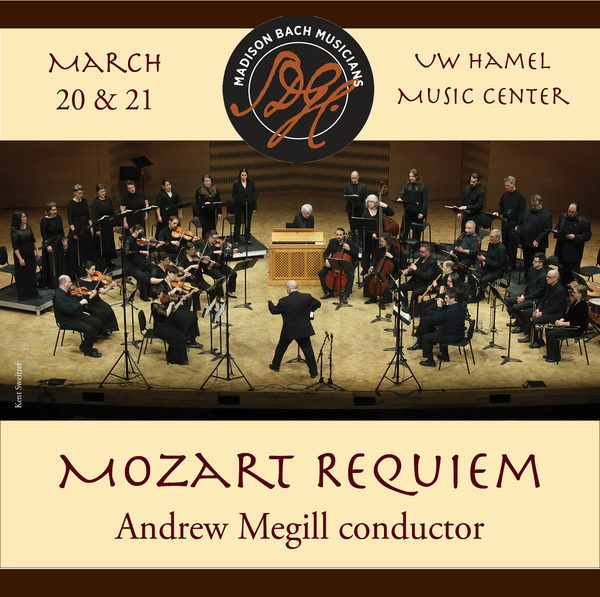
This program celebrates Mozart’s astonishing spiritual range from the unbridled joy and Italianate lyricism of the string serenade Eine Kleine Nachtmusik to the consummate lyricism and grace of Laudate Dominum’s solo soprano (Mozart’s favorite voice to write for); from the inimitable way he could say goodbye as in Così fan tutte’s famous Terzetto Soave sia il vento (conjuring in sound the warmest hug, the most profound look in the eye) to the Requiem’s dramatic consideration of mortal life’s end.


Early in 1791, Mozart was approached with a mysterious and anonymous commission to compose music for a requiem. Though his health was failing, he took on the commission at full force, eventually becoming haunted that the work was for his own death. Mozart had not yet completed Requiem by the time of his death in December 1791, but his pupil, Süssmayr, finished the work with a convincing 18th-century sensibility. This is the version which has been performed thousands of times ever since, including at Chopin’s funeral in 1849.


PROGRAM: Eine Kleine Nachtmusik, K. 525, Laudate Dominum, K. 339, Soave sia il vento (from Così fan tutte, K. 588), Requiem, K. 626


Read more
Event image

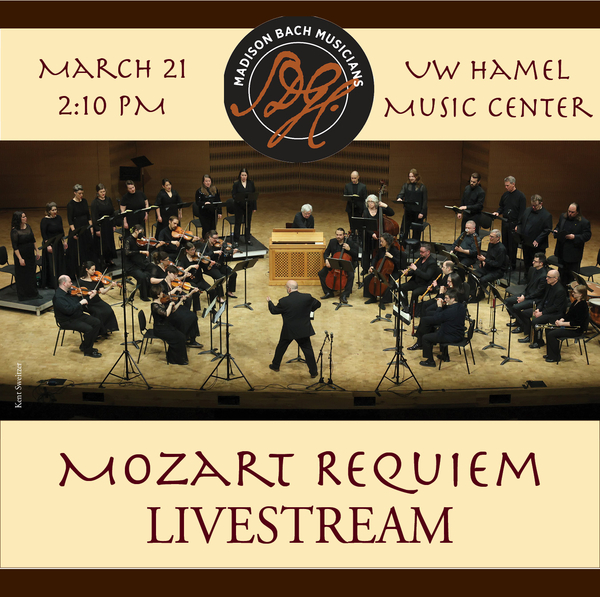
Mozart Requiem - LIVESTREAM

Sunday, March 21, 2027 - 2:10 PM CDT

Before God and as an honest man I tell you that your son [Wolfgang Amadeus Mozart] is the greatest composer known to me either in person or by name; he has taste, and, furthermore, the most profound knowledge of composition.—Joseph Haydn to Leopold Mozart in 1785


This program celebrates Mozart’s astonishing spiritual range from the unbridled joy and Italianate lyricism of the string serenade Eine Kleine Nachtmusik to the consummate lyricism and grace of Laudate Dominum’s solo soprano (Mozart’s favorite voice to write for); from the inimitable way he could say goodbye as in Così fan tutte’s famous Terzetto Soave sia il vento (conjuring in sound the warmest hug, the most profound look in the eye) to the Requiem’s dramatic consideration of mortal life’s end.


Early in 1791, Mozart was approached with a mysterious and anonymous commission to compose music for a requiem. Though his health was failing, he took on the commission at full force, eventually becoming haunted that the work was for his own death. Mozart had not yet completed Requiem by the time of his death in December 1791, but his pupil, Süssmayr, finished the work with a convincing 18th-century sensibility. This is the version which has been performed thousands of times ever since, including at Chopin’s funeral in 1849.


PROGRAM: Eine Kleine Nachtmusik, K. 525, Laudate Dominum, K. 339, Soave sia il vento (from Così fan tutte, K. 588), Requiem, K. 626


Read more

No more events to load